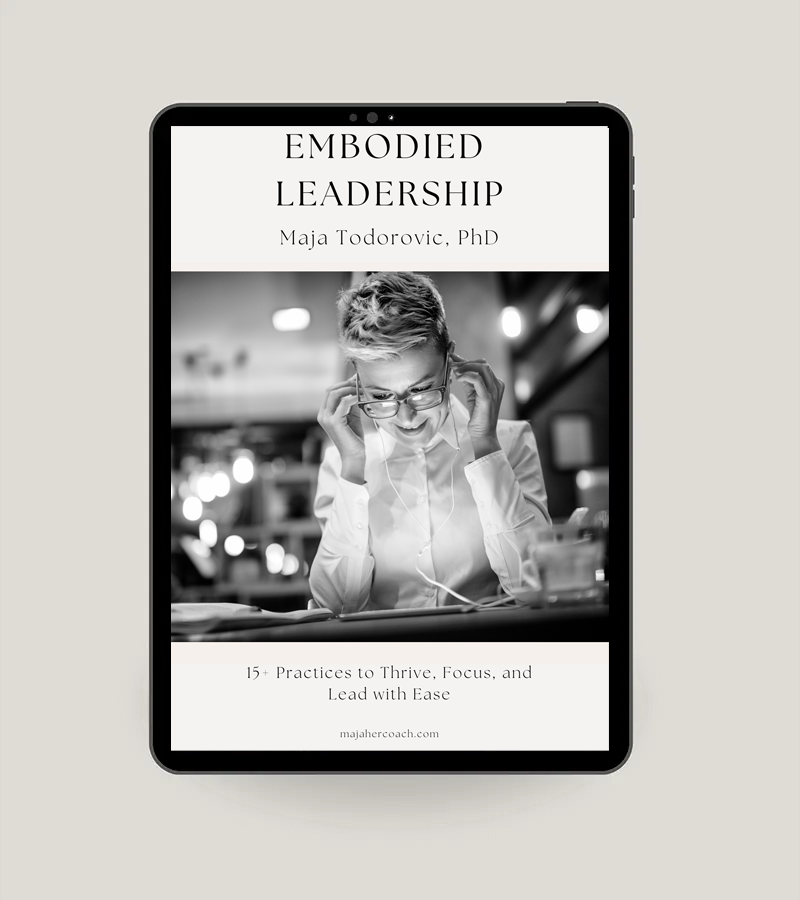
Leadership transformation from constant exhaustion and override to an embodied way of leading isn’t about becoming soft—it’s about becoming sustainable. Here’s what that looks like from the trauma-informed perspective—and why the vulnerable middle is where real change lives.
A snake doesn’t shed its skin because it wants to.
It sheds because it must. Because the old skin—the one that protected it, that kept it safe through an entire phase of life—can no longer contain what it’s becoming.
For days before the molt, the snake becomes vulnerable. Its vision clouds. Its colors dull. It retreats, exposed and tender, while the new skin forms beneath the old.
And then, in a process that looks like a struggle but is actually an emergence, it sheds what no longer serves it.
Not because the old skin was bad. But because growth demands it.
This is what the leadership transformation from override to embodied feels like.
Not a simple decision. Not a weekend workshop revelation. But a fundamental shedding of the protective armor that got you here—the relentless pushing, the constant proving, the override of every signal your body sent—because that armor can no longer contain who you’re becoming.
And just like the snake in mid-molt, this leadership transformation makes you vulnerable in ways you never anticipated.
The Collapse That Forces the Question
Most women leaders don’t choose this transformation.
They’re forced into it.
Sometimes it’s sudden: a health crisis that stops you mid-stride. Your body, after years of polite suggestions—the fatigue, the insomnia, the constant anxiety—finally demands to be heard.
Sometimes it’s slower: a melting, a disappearing, a gradual erosion you don’t notice until one morning you wake up and don’t recognize yourself. You’ve been so focused on the external—the title, the revenue, the facade of success—that you didn’t notice the cost accumulating inside.
You struggle to get out of bed. You drag yourself through meetings. You feel like you’re performing a role that once fit but now feels like a costume you can’t take off.
This is the moment most of my clients find me.
Not when they’re thriving and want to “optimize.” But when they’re barely surviving and something fundamental has to change.
They’ve been overriding themselves for so long—their capacity, their desires, their values, their body’s increasingly urgent signals—that they’ve forgotten what it feels like to lead from anywhere other than sheer force of will.
And the will, finally, has run out.
What Override Leadership Actually Costs
Let’s be specific about what “override leadership” means, because it’s not just about working long hours or being ambitious.
Override leadership is:
Ignoring your body’s signals—the exhaustion, the tension, the warning signs—because there’s always one more deadline, one more meeting, one more thing that “has to” get done.
Putting everyone above yourself. Your team’s needs. Your clients’ expectations. Your boss’s demands. Your family’s requirements. Everyone gets a piece of you until there’s nothing left.
Abandoning your passions, your hobbies, the things that once made you feel alive, because “there’s no time” and “maybe later” and “when things calm down” (they never do).
But here’s what nobody talks about:
Override leadership isn’t just about sacrificing self-care or working too hard.
It’s about overriding your internal wisdom.
You know—somewhere deep inside—that the way you’re leading isn’t sustainable. You know that micromanaging is killing your team’s creativity. You know that saying yes to everything is destroying your capacity. You know that the metrics you’re chasing don’t actually align with what you value.
But you override that knowing.
Because of fear. Fear of what colleagues will think. Fear of losing your edge. Fear of not being taken seriously if you lead differently. Fear of disappointing people who expect you to be the version of yourself you’ve always performed.
So you keep pushing. You keep performing. You keep chasing external validation instead of listening to the internal clock, the body wisdom, the quiet voice that whispers: This isn’t working. There has to be another way.
Until your body makes the decision for you.
The Messy Middle of Leadership Transformation No One Warns You About
Here’s what the leadership books don’t tell you about this leadership transformation:
It doesn’t feel like growth. It feels like loss.
You’re shedding the identity that got you here. The high-achiever. The one who can push through anything. The reliable one. The strong one. The one who never complains, never stops, never needs help.
And in the space between who you were and who you’re becoming, there’s nothing but questions and uncertainty.
I know this intimately.
After my brain injury, I spent months in what I now call the soil phase—a period where nothing visible was happening, but everything invisible was shifting. I wasn’t recovering in any way that people could see. I was just… waiting. Preparing. Learning to trust the smallest signals from a body I no longer recognized. It felt like stagnation. It felt like I was doing nothing while everyone expected progress. But my nervous system was quietly rebuilding its capacity to hold life again.
This is what leadership transformation looks like in the middle: invisible work that feels like nothing.
The hardest part isn’t learning new skills. It’s the loss of self-trust.
You’ve spent years—maybe decades—trusting your mind, your willpower, your ability to push through. And now you’re being asked to trust… your body? Your intuition? The subtle signals you’ve been trained to ignore?
It feels like stepping off a cliff with no guarantee of a landing.
You don’t know how to lead from your body when you’ve only ever led from your head.
The fears multiply:
If I slow down, will I lose my edge?
If I stop pushing, will I become irrelevant?
If I lead differently, will my team still respect me?
If I’m not the relentless achiever, who am I?
You worry you’re doing less. You worry you’re becoming soft.
The old metrics—hours worked, tasks completed, goals crushed—no longer apply. But you don’t yet have new metrics to replace them. So you feel like you’re floating in a space between identities, belonging to neither.
This is the vulnerable middle. The molting phase.
Your old skin is peeling away, but the new one hasn’t fully formed yet. You’re tender. Exposed. Uncertain whether this leadership transformation is growth or simply giving up.
And here’s the truth no one prepares you for:
You have to stay in this discomfort. You can’t rush it. You can’t willpower your way through it (that’s the old pattern, remember?). You have to learn to live in the liminal space—the space between what was and what’s becoming.
This is where most people turn back. Where they decide it’s too uncomfortable, too uncertain, too risky. Where they put the old armor back on and return to override, because at least that’s familiar.
But if you stay—if you learn to tolerate the vulnerability of becoming—everything changes.
What Actually Emerges from Leadership Transformation
Let me tell you what happens when you don’t turn back.
You start to embody safety.
Not perform it. Not fake it. Actually feel it in your body. You learn practices—breathwork, grounding, nervous system regulation—that aren’t just concepts but tools you use daily. Your body, which once felt like an enemy always threatening collapse, becomes a trusted ally sending you accurate information.
You start to trust yourself again.
But this time, the trust isn’t based on your ability to push through. It’s based on your ability to listen. To sense when you’re approaching capacity. To recognize the difference between discomfort that signals growth and dysregulation that signals danger.
You become more vulnerable, more transparent.
And here’s the paradox: this doesn’t make you weaker. It makes you more trustworthy. Your team stops walking on eggshells. Communication channels open. People bring you problems earlier because they’re not afraid of your reaction.
You create the conditions for trauma-informed leadership—not just for yourself, but for your entire team.
Because once you learn to recognize dysregulation in your own nervous system, you start recognizing it in others. You stop interpreting your team’s freeze response as incompetence or their fight response as insubordination. You understand that behavior is information about the nervous system state, not character.
You lead with compassion—first toward yourself, then toward others.
Not the soft, permissive kind that avoids accountability. The fierce, grounded kind that holds people capable while also recognizing they’re human beings with nervous systems that need regulation, not optimization.
You stop performing psychological safety and start embodying it.
Your team doesn’t just hear you say “this is a safe space.” They feel it in your body language, your tone, the way you respond when someone makes a mistake. They sense that you’re regulated, and their nervous systems co-regulate with yours.
And then something unexpected happens:
You become more effective. Not despite slowing down, but because of it.
Your decisions improve because you’re not making them from a dysregulated state. Your leadership stabilizes because you’re not swinging between hypervigilance and collapse. Your energy becomes sustainable—not the manic bursts followed by crashes, but a steady, grounded presence your team can rely on.
The Counterintuitive Truths of Leadership Transformation
Let me name the fears that keep you stuck in override—and the truths that dismantle them:
Fear: If I become vulnerable and transparent, I’ll lose authority.
Truth: Vulnerability doesn’t erode authority—performing invulnerability does. When you pretend you have it all together while your team can feel your dysregulation, trust fractures. When you’re honest about your limits and your process, authority deepens.
Fear: If I slow down and listen to my body, I’ll lose my competitive edge.
Truth: You’re not losing your edge—you’re sharpening it. Override leadership creates spiky, inconsistent performance: brilliant one day, dysregulated the next. Embodied leadership creates sustainable excellence.
Fear: If I lead with compassion, people will think I’m soft.
Truth: Compassion without boundaries is people-pleasing. Compassion with clear expectations and accountability is trauma-informed leadership. You can be kind AND hold people to high standards. The two aren’t mutually exclusive—they’re integrated.
Fear: If I stop doing everything myself, things will fall apart.
Truth: The belief that you have to do everything yourself is a trauma response (usually hyperresponsibility). Trauma-informed leadership distributes responsibility, builds trust in your team’s capacity, and creates collaborative structures. Things don’t fall apart—they stabilize, because you’re no longer the single point of failure.
Fear: If I make decisions based on body wisdom instead of pure logic, I’ll make mistakes.
Truth: You’ve already been making mistakes—just from dysregulation instead of presence. When you’re operating in survival mode, your prefrontal cortex goes offline. You lose access to nuance, perspective, creativity. Embodied leadership doesn’t abandon logic—it integrates somatic wisdom WITH analysis.
The most counterintuitive truth of all:
The leadership transformation you’re resisting isn’t making you weaker. It’s making you sustainable. And sustainability, in a culture that glorifies burnout, is the most radical act of leadership there is.
What This Leadership Transformation Actually Requires
If you’re in the messy middle right now—if you’ve realized you can’t continue leading the way you have been, but you don’t yet know how to lead differently—here’s what this transformation actually demands:
1. You Have to Grieve Who You Were
The high-achiever identity. The one who could push through anything. The version of yourself that earned praise, promotions, recognition for your relentlessness.
That version of you was real. She got you here. She deserves honor, not shame.
But she can’t take you where you need to go.
2. You Have to Learn a New Language
Your body speaks in sensations, not words. Tightness. Expansion. Heaviness. Lightness. Energy. Depletion.
For years, you’ve been fluent in the language of metrics and outcomes. Now you’re learning the language of capacity and regulation.
It feels clumsy at first. But with practice, this language becomes precise, nuanced, reliable.
3. You Have to Build Self-Trust from the Ground Up
Not the old trust (“I can push through anything”) but a new trust: “I can sense what I need and honor it.”
This means: Noticing when you’re approaching your edge—and respecting it instead of overriding it. Making decisions that align with your values, even when they’re unpopular. Saying no without guilt. Resting without earning it.
Every time you honor a boundary, every time you listen to a body signal, every time you choose regulation over override, you’re depositing into your self-trust account.
4. You Have to Accept That This Takes Time
The snake doesn’t shed its skin in one dramatic moment. The process takes days, sometimes weeks. There’s preparation, discomfort, patience.
You can’t rush becoming. You can’t optimize transformation. You can’t willpower your way into embodied leadership.
You have to live in the liminal space long enough for the new skin to form.
The Vision You Can’t See Until You’re There
Here’s what I wish I could show you—what my clients can’t fully believe until they experience it:
On the other side of this leadership transformation, you don’t just lead differently. You become different.
You walk into meetings grounded, not braced. You make decisions from clarity, not fear. You hold difficult conversations without your nervous system hijacking the moment. You sleep at night because you’re not carrying everyone’s problems in your body.
Your team changes too.
They stop bringing you half-truths and start bringing you real problems. They innovate more because they’re not afraid of your reaction. They trust you to handle complexity because you’re no longer swinging between control and collapse.
And something else happens—something harder to measure but impossible to miss:
You like yourself again.
Not the performance of yourself. Not the version you think others need you to be. But the actual, embodied, imperfect, present YOU.
You’re not perfect. You still have hard days. You still get dysregulated sometimes. But now you have the awareness to notice it, the tools to regulate it, and the self-compassion to not shame yourself for being human.
The Choice You’re Actually Making
If you’re reading this and something in you recognizes this transformation—if you’re in the middle of the molt or standing at the edge of it—I want you to know:
You are ready for outgrowing.
The leadership style that got you here wasn’t wrong. It was adaptive. It helped you survive environments that demanded override. It earned you credibility, promotions, respect.
But adaptation that becomes rigid is no longer adaptive.
The question isn’t “Should I change?” The question is: “Can I stay in this old skin without it killing me?”
And if the answer is no—if you’re already feeling the constraints, the exhaustion, the sense that continuing this way will cost you everything—then you’re already in the leadership transformation whether you’ve named it or not.
The only choice left is whether you’ll fight it or allow it.
Fighting it looks like: trying to recapture the old stamina, the old drive, the old version of yourself who could push through anything. Shaming yourself for needing rest, for feeling uncertain, for not being who you used to be.
Allowing it looks like: staying present in the discomfort of becoming. Learning the new language of your body. Building self-trust slowly, imperfectly, persistently. Accepting that you’re in the liminal space and you can’t rush it.
This is the hardest, most courageous work of leadership:
Not the public-facing kind. Not the kind that gets celebrated or promoted. But the quiet, internal work of shedding what no longer serves you so something truer can emerge.
Your Next Step
If you’re ready to stop overriding yourself and start the transformation to embodied leadership, here’s what I want you to know:
The molt is vulnerable not just because you’re shedding protection, but because you need different support during the process. You need someone who understands both where you’ve been and where you’re going.
This is the work I do.
I guide women leaders through this exact leadership transformation—from override to embodied, from survival to presence, from performing leadership to living it.
Not with quick fixes or productivity hacks, but with the slow, grounded work of nervous system regulation, somatic intelligence, and trauma-informed leadership development.
If you’re in the messy middle and you need support, reach out.
The leadership style that got you here can’t sustain you there.
But the leadership that’s emerging—grounded, embodied, sustainable, real—that leadership can carry you for decades.
You just have to be willing to stay in the molt long enough for it to form.