Women leaders under pressure don’t break down. They perform harder. They hold the room tighter. They absorb more, give more, carry more — until the cost becomes invisible even to themselves. For many women leaders under pressure, this comes with a hidden cost: reactivity that doesn’t feel like a choice. You can’t lead from genuine authority when your nervous system is running a survival programme underneath every decision you make. Your team feels your state before they hear your words. This is the paradox: how do you lead with clarity and calm when your own body doesn’t feel safe?
It’s 6:47 PM on a Tuesday and Katarina is still at her desk. The merger timeline has moved forward by three weeks. Her inbox is a wall of requests she hasn’t answered. Two of her best people came to her today, separately, to say they’re overwhelmed. She listened, nodded, said the right things. She did not tell them that she is drowning too.
Katarina is a regional manager in a global tech company midway through an acquisition. She’s standing between a leadership layer that cares only about timelines and profit margins and a team she has spent three years building trust with — people who are now looking at her with a question in their eyes that she cannot answer:
Is anyone going to protect us?
So she adapts. She works longer. She absorbs the pressure so her team doesn’t have to. She says yes to every new deadline because saying no has never felt like an option that belongs to her.
And something is happening in her body that she doesn’t have a name for.
In meetings with senior leadership, she feels heat rise in her chest, a sharp tightening behind her sternum. Her jaw sets. Her voice gets precise, clipped, almost hard — and she hates the sound of it even as it comes out. She is fighting. Not for her ego. For her people. But her body doesn’t know the difference between advocacy and survival.
And then, sometimes in the same afternoon, something else happens. The fight drains out and is replaced by something hollow. She watches her own hand take notes and feels oddly distant from it, as if she’s watching herself lead from behind glass. Her legs want to move. Her body is already gone.
She doesn’t name this either. She calls the fighting “advocacy.” She calls the fleeing “needing a break.” She calls the exhaustion “just how it is at this level.”
What Actually Happens to Women Leaders Under Pressure
When pressure rises, the body responds before the mind has time to think. The brainstem — the oldest, fastest part of the brain — reads the environment for threat and activates a survival response in milliseconds. The prefrontal cortex, where strategic thinking lives, is slower. Under sustained pressure, it goes functionally offline — not because she is weak, but because her biology is doing exactly what it was designed to do: keep her alive.
For women leaders under pressure, this means she is not reacting because she lacks competence. She is reacting because the part of her brain that holds her competence has been overridden by a part that is older, faster, and interested in one thing only: keeping her safe.
And her survival responses do not look like survival. They look like leadership. That is the problem.
The Grip
The woman who holds every detail because releasing control feels physically dangerous — she is not leading. She is gripping. Her body has decided that letting go is unsafe. She experiences the exhaustion of holding everything with white knuckles — the dread that loosens in her stomach when someone says “I’ll handle it,” because her body does not believe them. Trusting someone else with the outcome feels, in her nervous system, indistinguishable from danger.
The Escape
The woman who is always already moving to the next initiative, whose calendar is a fortress against stillness — she is not driven. She is running. Her body learned long ago that stillness is where the discomfort catches up. The exhaustion doesn’t arrive as a breakdown. It arrives as a slow, grey flattening — the colours draining from things she used to care about. She calls it “just being tired.” Her body knows it is something more.
The Disappearance
The woman who goes quiet in crisis — praised for her composure, trusted for her steadiness — she is not regulated. She has left her body entirely. Hands cold. Voice flat. Mind blank in the exact moment that requires her sharpest thinking. Her real response will arrive hours later — in the car, in the shower, at 2 AM when the room replays itself behind her eyes. By then, it is too late.
The Collapse Inward
The woman who softens every conflict, who reads the room before she reads herself, who says yes while her stomach turns — she is not collaborative. She is appeasing. She developed an extraordinary attunement to everyone else’s emotional state and a near-total blindness to her own. She pours herself out and calls it service. Her boundaries dissolve not from weakness, but from a deep, body-level conviction that her needs are less important than the discomfort of saying no.
These are not personality types. They are nervous system states — automatic, embodied, and running the leadership of some of the most accomplished women leaders under pressure in every sector, in every room where the stakes are real.
Why Women Leaders Under Pressure Cannot Resolve This With Mindset Alone
Most leadership development treats reactivity as a thinking problem. Reframe your mindset. Manage your triggers. Build resilience. The assumption is that if she understands the pattern, she can override it through willpower. This is why it doesn’t work.
This is why so many women leaders search for how to stay calm under pressure at work — and find that mindset tools don’t reach the level where the pattern actually lives.
The Pattern Lives in the Body, Not the Mind
The pattern was wired into the body long before the corner office. In childhood. In early career. In every moment where she learned what happened when she spoke too directly or took up too much space. That wiring does not update itself when she gets promoted. It runs the same programme in the boardroom that it ran in the classroom, in the family kitchen, in every formative moment where her body learned that certain expressions of authority were dangerous for a woman.
She can understand her patterns perfectly — and still find herself gripping the table in a meeting, or going silent when she should speak. Because understanding happens in the prefrontal cortex. The survival response happens in the brainstem. They operate on different timescales. The body is always faster.
Why You Can’t Think Your Way Out
She knows better. She can see it with perfect clarity after the fact. But in the moment itself, something else takes over. Something faster. Something older. Something that does not respond to insight or willpower. That gap — between what she knows and what her body does — is not a personal failing. It is the architecture of the nervous system doing exactly what it was designed to do. And no cognitive intervention can close it, because the pattern does not live where cognitive interventions can reach.
A Gendered Cost Women Leaders Under Pressure Carry
Women in organisational power navigate a paradox that has no male equivalent: she must be visible enough to lead and invisible enough to be tolerated. These negotiations happen in the body — in the voice that lifts at the end of a declarative sentence, in the shoulders that round before delivering difficult feedback, in the breath that catches before she says what she means.
Over twenty years, these micro-adaptations compound into a somatic signature she carries into every room without knowing it. This is why the cost for women leaders under pressure is not just exhaustion. It is the somatic cost of decades of leading from a body that has never been told it is safe to put the armour down — because the environment never made it safe to do so.
Signs Women Leaders Under Pressure Are Leading from Survival
You feel calm until suddenly you don’t — and the shift catches you off guard, as though something inside you flipped before you had any say in it.
You replay conversations after meetings — not to learn from them, but because your body is still activated. Chest tight, mind circling, the interaction still alive in your nervous system hours later.
You say things in high-stakes moments that do not sound like you. Sharper than you intended. Or quieter. Or more accommodating than you actually feel.
You overcorrect after conflict — either pulling back entirely or overgiving to restore a harmony you are not sure was yours to maintain. Both responses feel automatic. Neither feels like a choice.
You have read the books. Done the programmes. And yet the pattern returns the moment pressure rises — not because the work didn’t help, but because it addressed the mind while the body kept running the old programme underneath.
If you recognise yourself here, it is not because something is wrong with your leadership. It is because your nervous system is leading on your behalf — running a map drawn long before your current role existed.
Awareness is the first step
It is 8:15 PM and Katarina is sitting in her car in the company parking garage. The engine is off. Her hands are still on the steering wheel.
She is crying. Not the kind of crying that comes from sadness — the kind that comes from a body that has been held so tightly for so long that it has finally found a crack to pour through.
She thinks about her daughter’s face at breakfast this morning — the careful way she said, “Mummy, you look tired,” as if she was trying not to be a burden. She thinks about the last time she laughed without checking the time.
She is not burned out. She is not weak. She is a woman who has been leading from survival for so long that she has forgotten there is anything underneath the armour.
And in this moment — hands on the wheel, engine off, tears falling — something shifts. Not a solution. Something quieter. A recognition. That the fighting and the fleeing are not separate problems. They are the same pattern, alternating. That she has been calling this “stress” and “just how it is at this level” — but it has a different name. A more precise one. One she hasn’t learned yet.
She doesn’t know what the pattern is called. She doesn’t know how to shift it. But for the first time, she knows — in her body, not just in her mind — that she cannot keep leading this way.
That is the doorway. The moment a woman stops calling her survival “leadership” and lets herself see what is actually happening underneath. Most women leaders under pressure have never had that moment. Not because they are not ready, but because no one has given them the language — or the mirror.
If you recognise yourself in this, the question is not whether you are capable of leading differently.
It’s whether you can see the pattern clearly enough to stop calling it “just pressure.”
The Embodied Authority Audit
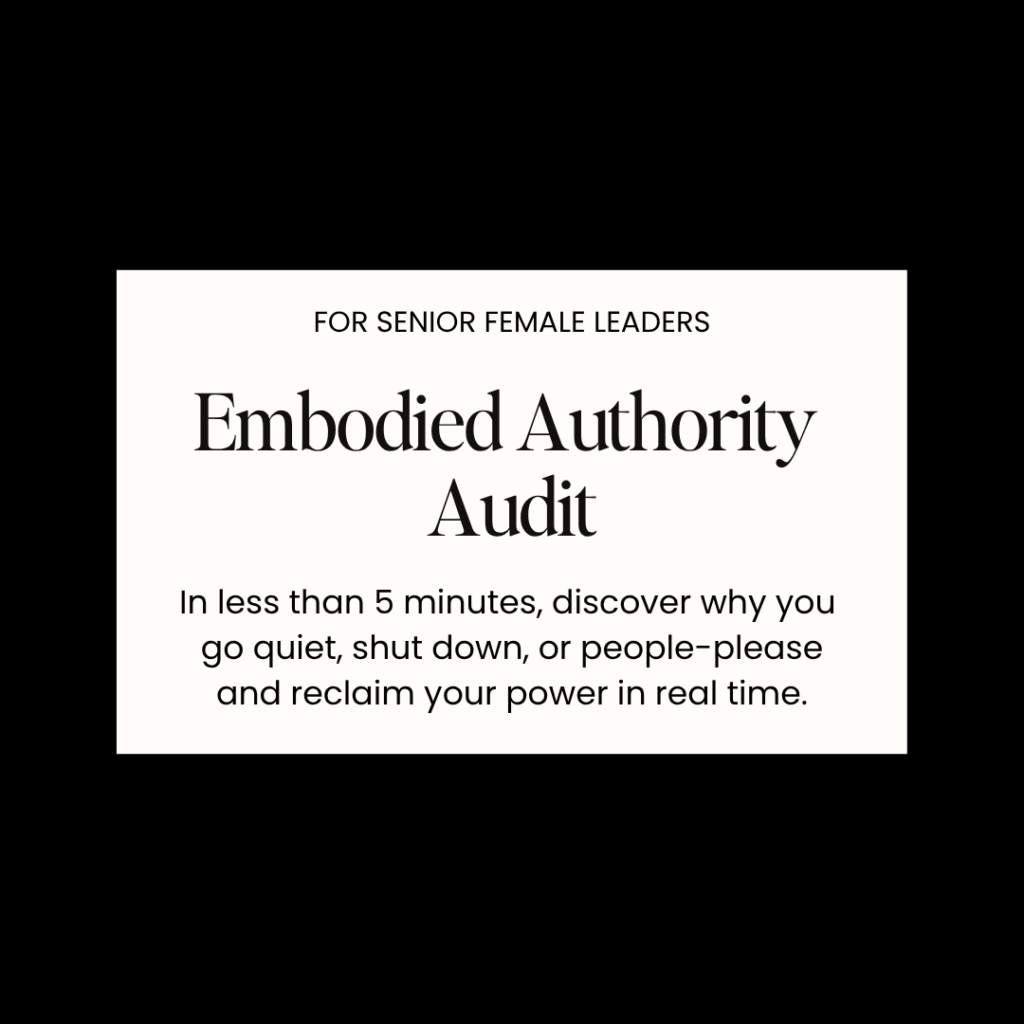
This is why I created the Embodied Authority Audit — a free self-assessment designed specifically for women leaders under pressure who are ready to understand what is actually driving their leadership when the stakes are highest.
In less than ten minutes, you will discover your dominant nervous system pattern under pressure, understand how it shapes your decision-making and your boundaries, and receive a somatic practice designed for your specific pattern — not a generic tool, but a practice matched to the way your body actually responds.
You are not at the beginning of your leadership. You are at the edge of a different level of it. What you do with that awareness is entirely yours.
Take the Free Embodied Authority Audit → and discover how you actually respond under pressure.