Embodied authority for women is the capacity to remain connected to clarity, regulation, and leadership presence under pressure. This guide explores the six developmental levels of embodied authority for women and how nervous system integration shapes executive presence, influence, and leadership effectiveness.
Two women, two boardrooms, same Tuesday morning. Same résumé, more or less — both vice presidents at multinational companies, both have spent the last decade earning their way into rooms like these, both have prepared meticulously for the conversation about to happen.
Within ninety seconds of the first hard question, you can tell they are nowhere near the same place.
The first leader feels the question before she fully hears it. Her chest tightens. Her jaw locks. Her voice, when she finds it, is a half-step higher than it was a moment ago, and her sentences start running into each other — too many words, too quickly, trying to cover the ground between the question and her authority. By the time she finishes speaking, the room has registered something it cannot name. The board member presses again. She doubles down. The conversation has already shifted, and not in her favor.
The second leader feels the same question land in her body. The same tightening at the chest, the same heat at the back of the neck. But something else happens before she opens her mouth. Her breath drops. Her weight settles. She lets a beat pass — long enough to be felt in the room, not long enough to be awkward — and then she answers. Two sentences. Specific. Boundaried. She doesn’t argue. She doesn’t soften. The board member nods, marks something on the page, moves on.
The two women have done the same preparation. They’ve said roughly the same things. What was different was not what they said.
It was what their nervous systems signaled before they said anything at all.
The Territory of Embodied Authority for Women
This is the field most leadership development never reaches. For women leaders especially, this gap is consequential. We are trained, often before we know we are being trained, to translate authority through accommodation. To speak more softly when the room gets harder. To smile through a sentence we mean seriously. To explain when we should be deciding. The early scaffolding of women’s leadership is built on top of a nervous system that learned, at some point, that being palatable was safer than being clear.
That scaffolding holds for a while. Then a Tuesday morning arrives, and the scaffolding shows.
Embodied authority for women is not the absence of activation. It is not the eradication of fear, of pressure, of the heat at the back of the neck. It is the integration of all of these into a body that can stay with itself — and eventually, hold a room — while everything is still happening inside it.
There are six measurable levels of this integration. Three thresholds the body crosses on the way to authority that no longer needs force to be felt. What unfolds between the first woman and the second across those six levels is not a transformation. It is an integration. The first leader is not broken. She is at an earlier place in a developmental arc the second has already walked. Both will continue walking it. So will you.
What follows is the map — six levels, three thresholds, and what each one asks of the body before it lets you through.
The Integration Frame: Why Somatic Development Replaces “Fixing”
Most leadership development gets this wrong.
The dominant story sold to women leaders is one of escape. Rise above your reactivity. Get past your nerves. Transcend the parts of yourself that don’t yet meet the moment. The implicit premise is that the activated body is something to be left behind, like an outgrown wardrobe — and that authority is what’s waiting on the other side of the leaving.
This is not what the developmental research shows. It is also not what actually happens in the bodies of women leaders who arrive at authority that can hold a room.
What happens is integration.
The activated nervous system that hijacked the first leader does not disappear in the second leader. It is still there. The heat at the back of the neck still arrives. The chest still tightens. What is different is that her body has built capacity around those signals — not above them, not in spite of them — capacity that allows the signals to register without taking the wheel.
This is closer to how senior leaders actually develop in any domain. You don’t stop being the analyst when you become the VP. The analyst capacity is still there, folded into a larger role. The executive who can still do the underlying work has more authority, not less, than the one who has cut herself off from her earlier competence. Integration is what allows scale.
Embodied authority for women works the same way. The earlier levels do not get replaced. They get folded in. The leader at Level 6 still has access to the activation patterns of Level 1 — she just doesn’t get run by them. They become information. They become signal in a wider field of signal.
This is the central methodological commitment of the work that follows: every level is permanent. None is left behind. The six levels are not a ladder where each rung is climbed and discarded. They are layers in a body that is learning to hold more.
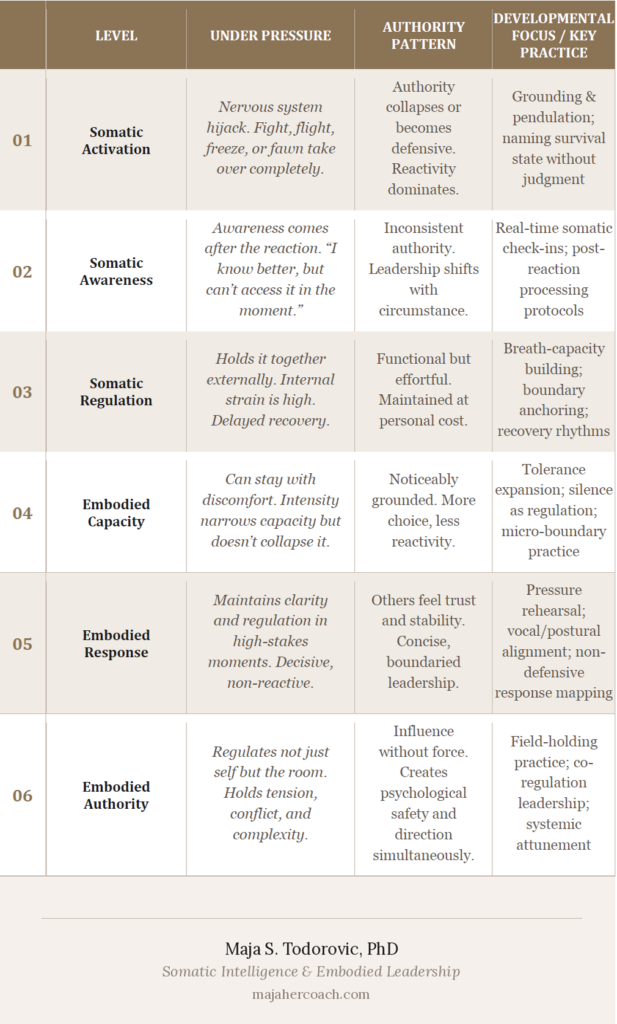
The threshold between any two levels is not a transformation. It is a thickening.
Threshold One of Embodied Authority for Women: From Activation to Awareness
Return to the first leader for a moment.
She has not failed her preparation. She knows what she came to say. The case is sound, the data is clean, the strategic logic holds. None of that is the problem. The problem arrives below the level of thought, in a place her preparation could not reach.
This is Level 1: somatic activation. Nervous system hijack. Fight rises and her voice gets harder. Flight rises and her sentences speed up. Freeze rises and the answer she had a moment ago is no longer there. Fawn rises — and this is the one women leaders are most often trained into — and she softens a position she meant to hold, smiles through a sentence that needed weight, agrees with a question she was supposed to answer. Whichever shape it takes, the survival system has taken over what was supposed to be a strategic conversation.
She does not know this is happening yet. That comes later.
What the room knows is something else. The board member who pressed the question does not consciously register that her nervous system is doing what it’s doing. He simply registers that something is off, and his own system calibrates accordingly. He presses harder, not because he’s hostile, but because his body has just learned that this conversation is going to require more force than he expected. This is what authority collapse looks like at the relational level. It is not heard. It is felt.
This is also, importantly, what her team is learning. The colleagues watching from across the table are not analyzing her authority. They are absorbing it. They are calibrating their own future behavior — what to bring her, what to handle without her, when to push back, when to go around her — to the somatic signature she has just transmitted under pressure. Authority is taught by the body, downward through the system, before any of it is taught by words.
Level 2 is when she starts to see.
The hallmark of somatic awareness is the painful gap: I know better, but I can’t access it in the moment. The insight is there. The strategic clarity returns the second she walks out of the room. She replays the meeting in her car and can name, precisely, what she would have done instead. She has the analysis. What she does not have, yet, is the timing.
This is the most disorienting level on the map. It is also the one most often mistaken for a personal failing. It is not. It is a developmental phase, and it is exactly where the work begins.
The threshold between these two levels is not more self-control. It is the slow, repetitive building of a particular kind of attention — the kind that allows the body’s signals to be noticed without being judged, noticed earlier, noticed without the cognitive override that pretends they aren’t there. The practices that build this attention are unglamorous. Grounding. Pendulation. Real-time check-ins. Naming the survival state — I am in fawn right now — without the secondary layer of shame about being in it.
The body learns to see itself.
Threshold Two of Embodied Authority for Women: From Activation to Awareness
Some months later, the first leader returns to a similar room.
She has done the work. She has named her patterns. She has learned to feel the heat at the back of her neck before her voice changes — sometimes. She has built the early scaffolding of somatic awareness. And she walks in to this next high-stakes conversation with a kind of armored composure — jaw deliberately soft, voice low, posture intentional. She does not let the activation show.
She is at Level 3. Somatic regulation.
From the outside, this looks like progress. From the inside, it is exhausting. The activation is still arriving — she has not transcended it, no one does — but now she is using a great deal of internal force to keep it from showing. Her shoulders are doing one thing while her face is doing another. She holds the line, but she pays for it. By Wednesday she is depleted. By Friday she snaps at everyone. By Sunday she is dreading Monday. She has, in effect, become very good at being a leader who is also very tired.
This is where many high-functioning women plateau.
The Level 3 trap is that it works. It produces the outcome the room wants. Authority looks intact. Composure is maintained. Performance is sustained. The cost is paid privately, and the system does not see the cost, and so the system does not adjust. Many women arrive here and assume they have reached the destination, only to discover that the destination is a treadmill.
The threshold into Level 4 is not more discipline. It is the opposite.
Embodied capacity is what happens when the body stops needing to suppress what is moving through it. The activation arrives. It is allowed to arrive. She does not have to do anything about it in order to remain herself. The intensity narrows her capacity slightly — it always does — but it does not collapse it.
Now consider the second leader.
She felt the same activation the first leader felt. She was not exempt. What she had built, through years of unglamorous practice, was tolerance. Her body could hold the question without going to war with itself in order to look composed. The beat she let pass before answering was not a performance of presence. It was the actual time her system needed, and she had built the capacity to give it that time without anyone in the room — including her — needing to fill the silence.
This is the level where authority stops costing the body what it once did.
It is also the level where the relational field begins to change. The people around a Level 4 leader stop bracing. They may not be able to name why. Meetings become slightly less effortful. Conflict becomes slightly less catastrophic. The leader has done nothing different, behaviorally. What has shifted is what her body is no longer asking the room to hold for her.
The practices that build this level are not the dramatic ones. They are micro-boundaries — the smaller no, said earlier, before the larger no becomes necessary. They are breath-capacity. They are silence used as regulation rather than avoidance. They are recovery rhythms strong enough to allow real pressure without permanent depletion.
The body learns to stay.
Threshold Three of Embodied Authority for Women: From Response to Embodied Authority for Women
A year on, the first leader walks into a board meeting that, by every external measure, should be the hardest of her career.
The strategy she has championed has run into a wall. A senior board member has gathered ammunition for the meeting and intends to use it. The room knows this. She knows this. There is no version of this conversation that does not include real challenge.
She has crossed into Level 5.
Embodied response is what Level 4 capacity becomes when it has been pressure-tested in many rooms. It is no longer just the ability to stay with discomfort. It is the ability to act from inside that discomfort with clarity and economy. When the board member opens the challenge, she does not match the heat. She does not absorb it. She does not deflect. She answers, in three sentences, precisely what the data shows and where she stands. She holds the boundary of her position without holding it tightly. She is decisive without being defensive — a combination most leadership development cannot teach, because it cannot be taught at the level of behavior. It can only be taught at the level of the nervous system.
The room registers this. The other board members lean forward slightly. The challenge does not stop, but it changes shape. It becomes inquiry rather than attack. The leader has not won the room by overpowering it. She has changed what the room is doing.
This is the level where the second leader has been operating from the first scene.
Now consider what is different about her at Level 6.
Embodied authority for women is what happens when a leader’s nervous system becomes a stabilizing presence for the bodies around her. She is no longer only regulating herself. She is regulating the field. The team can borrow regulation from her in the way a younger nervous system borrows regulation from an older one — quietly, below the level of language, as a function of proximity. She does not have to announce that she is steady. They feel it, and their own systems calibrate downward into it.
This is what allows her to do the thing most leaders cannot do simultaneously: create psychological safety and direction at the same time.
Ordinarily these two trade off. The leader who creates psychological safety often does so at the cost of clarity — she softens, accommodates, becomes pleasantly indistinct. The leader who creates direction often does so at the cost of safety — she sharpens, drives, becomes impressive but not approachable. A Level 6 leader does not have to choose. She can hold the tension of a hard conversation without leaking it into the room as pressure. She can name what needs to be named without anyone in the room going into survival. Influence happens without force, because force is no longer the means of transmission. The body is.
The practices at this level are different in kind from the earlier ones. They are not about the leader’s body in isolation anymore. They are field-holding practices. Co-regulation work. Systemic attunement — the capacity to feel what the room needs before the room can articulate what it needs.
The body learns to hold.
The Expanding Field of Embodied Authority for Women
Step back from the six levels for a moment and watch what just happened.
The early levels — activation, awareness, regulation — describe a leader’s relationship to her own body. The work is interior. The field she is learning to occupy is the field of her own skin.
The middle levels — capacity, response — extend that field outward. The body is no longer the only thing being regulated. The space between the leader and the people directly around her becomes part of the somatic territory. What she does with her breath in a one-on-one becomes information her direct report’s body uses.
The final level expands the field again. At Level 6, the leader’s nervous system is shaping the regulation of a room — sometimes a team, sometimes an organization, sometimes a system she does not even see the edges of.
The somatic field expands at each threshold. Body. Relationship. Room. System.
This is what most leadership development frameworks miss. They operate at the level of behavior. They teach what to say, how to stand, what tone to take, when to push and when to pause. None of this is wrong. None of this is enough. Because the audience for leadership is not the conscious mind of the people in the room. It is their nervous systems. And nervous systems do not read behavior. They read field.
A leader who has built her field has built something behavior alone cannot reach. She does not have to perform authority. The authority is now structural — present in the room before she speaks.
The Slow Work of Becoming a Body That Holds a Room
Return one last time to the two leaders.
They began this piece on the same Tuesday morning, in two different boardrooms, in front of two different boards. By every metric of credential and competence, they were identical. By the only metric that mattered — what their nervous systems were transmitting before they said anything at all — they were oceans apart.
That distance is not a personality difference. It is not a confidence problem. It is not a function of whether one woman was more naturally gifted than the other. It is a developmental distance, and developmental distances are walkable. Slowly. Through practice that is unglamorous and repetitive and almost never visible in the moment. The first leader has crossed two thresholds. She will cross the third. The second leader did not arrive at field-holding authority by being chosen for it. She built it, one capacity at a time, over years.
There is no shortcut. There is also no ceiling.
The Embodied Authority methodology — and the white paper that lays out its full architecture — exists for women leaders who recognize themselves somewhere in this map and want a precise account of what the next threshold actually asks. It maps each of the six levels in full clinical and somatic detail, the practices that build each capacity, and the patterns that most often stall a leader at the level she is currently on.
Download the White Paper: The Embodied Authority Methodology
Authority is built in the body. So is the field it shapes. There is no destination — only the next threshold, and the body that will know when it has been crossed.