Leadership under pressure is often treated as a test of strategy, speed, and composure. Yet many of the decisions leaders later regret happen in the split second between a question and an answer.
This article makes a different claim: the pause under pressure is not a technique. It is the place where the body becomes legible enough for real decision to emerge.
The Greeks had three names for time, and only one of them describes how the most important decisions are actually made.
Leadership under pressure runs through all three qualities of time the Greeks named, and each one asks a different question of the leader inside the room. Chronos is the sequential clock — the corporate calendar, the fifteen-minute slot, the second before silence is read as weakness. Kairos is the qualitative right moment — the ripe instant that appears in the interruption and cannot be scheduled. Aion is the horizon — the longer arc against which a leadership actually accumulates. The pause that produces real decision cannot be understood inside any one of them alone.
“I answered before I knew what I was answering.” Andrea said it flatly, three days after the board meeting she had spent six weeks preparing for. She was the Chief Operating Officer of a large company scaling into three new markets, and the board chair had asked her a question she had rehearsed with her CFO the week before. The strategically correct answer left her lips before her body had registered what the question was actually asking. The room heard commitment where she had intended calibration. Two weeks of internal reversal followed. The strategy was right. The timing was catastrophic, and the cost of the timing outran the strategy by an order of magnitude.
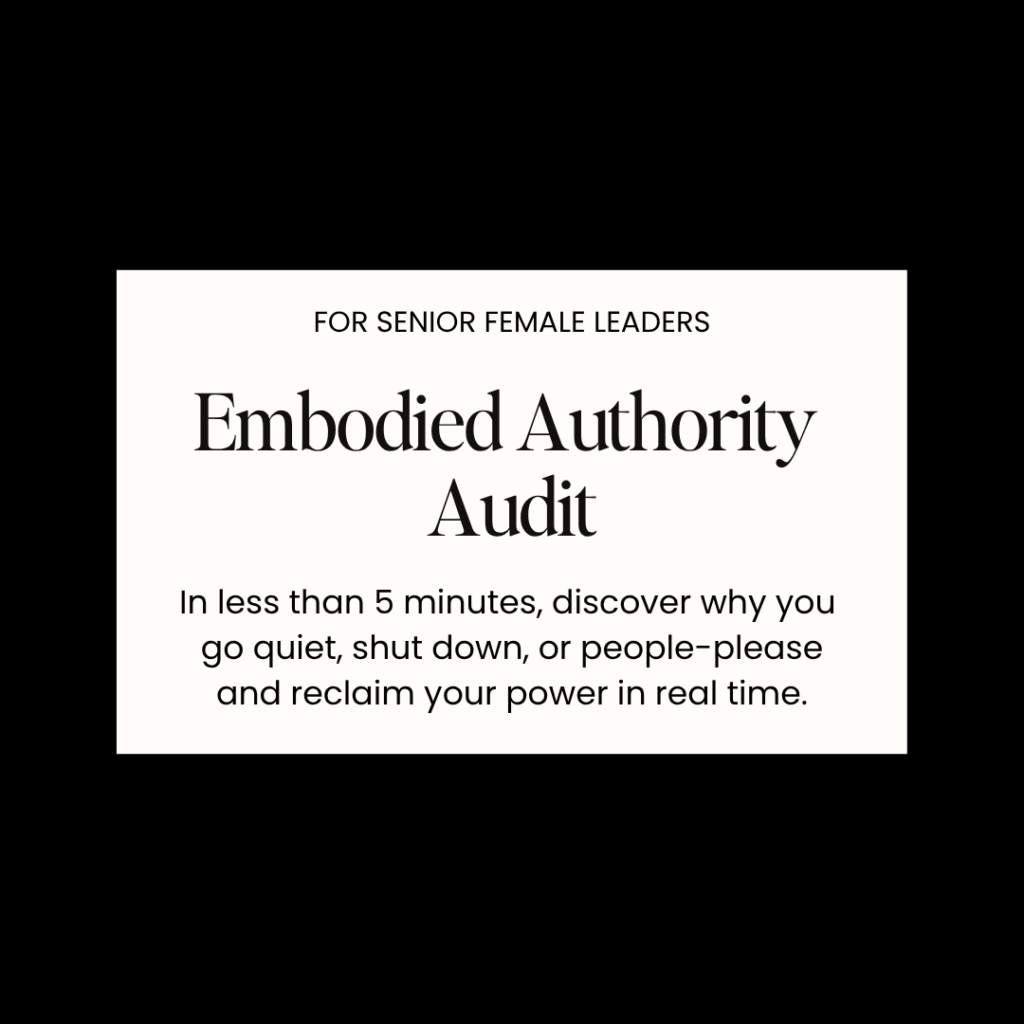
What Andrea described in that session — and what she keeps returning to as we work — is not a strategic failure. She had the analysis. She had the market data. She had the operating model rehearsed to the sentence. What her leadership under pressure did not have, in the second between the chair’s question and her answer, was access to the somatic information her body was registering about the room. The pause that would have made that information legible collapsed under pressure. She answered from Chronos, not from what her body was already tracking.
The specific moment differs; the shape recurs. The reactive email sent between meetings before the body had registered what the sender was actually feeling. The yes delivered to the executive committee while the diaphragm was already tightening around the no. The composed answer held through a piece of feedback while the sympathetic aperture narrowed and the fine information about the room went missing. Senior women recognise these moments not as failures of strategy but as the specific texture of answering from Chronos while the body was tracking something the answer never reached.
Leadership under pressure inside Chronos time
Leadership under pressure inside Chronos time asks the body to comply with the strategic timeline. Chronos in the Greek framing is sequential, measurable, indifferent — the clock the corporation runs on, the quarterly cycle, the fifteen-minute board slot, the second between a question and the moment silence begins to be interpreted as weakness. Under Chronos, response time becomes a proxy for competence. The leader who takes too long is read as uncertain, and uncertainty in the pressured room is read, particularly for senior women, as the absence of authority.
Somewhere in the last thirty years of executive culture, speed became conflated with intelligence. The fast answer signals mastery. The immediate response signals command. The leader who turns a complex question into a crisp reply inside a single beat is read as the leader who has already thought about it, and the pressured room rewards the speed with attention. The confusion is old and it is expensive. Speed in leadership under pressure is not a measure of decision quality. It is a measure of how well-rehearsed the sub-cortical pathway has become. What the room reads as command is often the delivery of a prepared answer through a nervous system that has not yet perceived what the moment is actually asking. The strategy is intact. The perception is missing. Senior decisions fail on missing perception far more often than on missing strategy, and the cost of the missing perception rarely appears on the same quarter as the decision that produced it.
The problem is that Chronos is not the time signature the nervous system runs on. Bruce McEwen’s research on allostatic load describes what happens when the body is asked, repeatedly and over long horizons, to hold physiological states that the environment demands but the organism cannot sustain. The cost accumulates. It shows up in cardiovascular markers, immune function, sleep architecture, and — the piece rarely discussed in leadership discourse — in the shrinking capacity to distinguish between what is actually happening in a room and what the body is bracing for. Under sustained Chronos pressure, the leader loses the fine-grained perception on which strategy depends. What emerges instead is speed. Speed masquerades as decision, and the room accepts the substitution because Chronos rewards it.
What the body registers in the split second before response
Between the question and the answer, the body is doing work the strategic mind is not aware of. Stephen Porges’s polyvagal theory offers an explanatory lens, not a settled mechanism, for what may be happening: the vagal system continuously appraises safety cues in the environment and shifts physiological state accordingly, and the aperture that state produces determines what the leader can perceive. In ventral vagal state, the room registers with a resolution reactivity cannot match. In sympathetic activation, the aperture narrows. Interoception research — the capacity to perceive internal bodily states, associated with the work of Sarah Garfinkel and colleagues — suggests that leaders with higher interoceptive accuracy make more calibrated decisions under uncertainty, not because they are more rational but because they are receiving more information from the body’s own tracking system. The split second before response is not empty. It is the window in which that continuous appraisal becomes available to conscious decision, if the leader can stay long enough in the interruption to receive it.
Andrea, in the board meeting, did not stay in that window. The question landed, the sympathetic aperture narrowed, the rehearsed answer moved through the sub-cortical pathway that had prepared it, and the fine-grained information her body was tracking about the chair’s actual concern never became legible. The pause that would have made it legible was there. It lasted perhaps a hundred and fifty milliseconds. She answered through it, and the room received the answer she had prepared rather than the answer the moment was asking for.
Why the popular pause fails leadership under pressure
The popular discourse on the pause treats it as a technique. Breathe. Count to three. Notice the sensation. Return to the task. There is a version of this that is genuinely useful, and there is a version — increasingly dominant in corporate wellness programming — that functions as performative nervous system regulation. The distinction matters because it determines whether the pause produces perception or suppresses it.
Performative nervous system regulation asks the body to comply with a script of calm. The breath deepens, the shoulders drop, the face composes itself, and the leader signals to the room and to herself that she is regulated. What has actually happened, in many cases, is that the vagal brake has been manually engaged — the parasympathetic response performed rather than achieved — while the sympathetic activation continues underneath. The signals the body was sending are not received. They are overridden by the technique. The leader who has learned to pause without learning to feel what the pause is for has learned a more sophisticated way to answer from Chronos.
Corporate mindfulness washing accelerates this. The programme rolls out, the language of nervous system regulation enters the leadership vocabulary, and the deeper claim — that the regulated body is an instrument of perception, not a display of composure — gets flattened into a set of breathing exercises that can be performed between meetings without interrupting the underlying allostatic load. Leading under pressure through the performative pause is still leading under pressure from Chronos. The physiology has not shifted; only the leader’s self-report has.
Two pauses that look identical from outside
From outside the room, the performative pause and the receptive pause are indistinguishable. Both look like the leader has taken a beat. What separates them is not visible on the surface, which is why the popular discourse collapses them so easily. The distinction lives in three places, and each of them can be tracked in real time by the leader herself.
The first is orientation. The performative pause is oriented toward output — the leader is inside her own head, composing the next sentence, monitoring how she is landing. The receptive pause is oriented toward the room — she is registering what the environment is doing, what the other bodies are tracking, what the actual question underneath the stated question is asking. Same second, different address.
The second is attention. In the performative pause, attention is running the internal review: is my face right, is my tone right, am I about to sound uncertain. In the receptive pause, attention is running interoceptive tracking: what is my chest doing, where has my breath moved, what is my diaphragm registering about this room. The attention has turned toward the somatic ledger rather than toward the performance.
The third is what the pause is for. The performative pause exists to produce a better-delivered answer. The receptive pause exists to receive what the moment is offering before the answer forms. The first serves Chronos. The second is the condition for Kairos.
The distinction is not theoretical, and it does not require a technique to apply. In the next pressured meeting, it can be tracked in a single question, asked inside the interruption: is my attention on my own output, or on what my body is registering about this room. That question is what allows a leader to know which pause she is inside, and to move deliberately toward the one that produces perception rather than the one that produces performance. The stance is observation, not another criterion for self-judgment. What the leader finds inside the interruption is not a grade. It is information.
Kairos and the body that perceives the moment
Kairos in classical Greek rhetoric was never a technique. In Gorgias and Isocrates, Kairos was the qualitative right moment — the ripe instant when an argument would land, when the room was ready to hear what could not have been heard a minute earlier. The rhetoricians treated it as a perceptual capacity. The skilled speaker did not create Kairos. He recognised it. He felt it arrive and he moved with it, and the same words spoken a beat earlier or later would have missed.
The claim embodied authority makes, and the claim I have been working with clinically for several years, is that the regulated body is the instrument by which Kairos is perceived. The pause under pressure does not produce the right moment. The pause produces the physiological condition in which the right moment, when it appears, can be received. Without the regulated body, Kairos passes through the room and the leader answers on the Chronos beat. With the regulated body, the same second contains information the reactive nervous system cannot access — the shift in the chair’s posture, the half-question underneath the stated question, the pull of the room toward a decision that has not yet been named.
Leadership under pressure from the regulated body
Leadership under pressure from the regulated body is not slower. It is more accurate. The interruption Andrea and I worked toward in the months after that board meeting was not a longer pause. It was a different quality of pause — one in which the ventral vagal aperture stayed open long enough for the somatic information to become legible before the answer formed. In the sessions, we mapped her signals: the specific tightening under the sternum that indicated the chair’s concern was not the one he had stated, the shift in her jaw that tracked the moment the room turned, the settling in her diaphragm that registered when a decision had actually landed. Her somatic ledger became precise.
When she returned to a board meeting six months later, the pause was not visible from outside. It lasted perhaps four hundred milliseconds — a length the room would read as considered rather than uncertain. Inside it, she registered that the chair’s question was structured around a concern he had not named, that her CFO had already reached a conclusion beside her, and that the correct answer was not the one she had rehearsed but a smaller, more precise one that named the underlying concern before addressing the stated question. The answer emerged from what she had perceived. It landed. The room turned. The strategic outcome was better than the rehearsed answer would have produced, and Andrea knew, in the body, that it was better before the chair spoke.
This is the claim the whole framework is built on. Leadership under pressure at the level real senior decision requires is not a function of strategy plus composure. It is a function of the regulated body’s capacity to perceive Kairos when Kairos appears, and to source the response from what has been perceived rather than from what has been prepared.
The horizon of Aion
The Greeks kept a third quality of time in view. Aion was the horizon — the longer arc, the time of the gods, the cyclical unfolding that Chronos measures but does not contain. For the senior leader, Aion is the time signature of the career, the institution, the relationship to a longer purpose than the quarterly cycle. Kairos serves Aion. The right moment perceived and answered from the regulated body is the moment that compounds into the leadership arc that Chronos alone cannot produce.
The arithmetic of this over a decade of senior decisions is what makes Aion the highest stake of the piece. A leader answering from Chronos accumulates decisions that were strategically correct and perceptually thin. A leader answering from Kairos accumulates decisions that are stone by stone building an arc. Over a quarter the two look similar. Over five years, over ten, over an institution, they are not the same leadership. Aion-scale leadership and quarterly-cycle leadership are two different games played on the same board, and only one of them produces the authority that outlasts a tenure.
For senior women, this distinction is not neutral. Aion has historically been the horizon male peers are granted by default — the assumption of vision, the long view, the arc that need not justify itself against the current quarter. Women in senior seats are more often measured against Chronos: the immediate result, the visible output, the answer delivered inside the fifteen-minute slot, the composure held under a piece of feedback. To claim Aion is not only a shift in time signature. It is a refusal to lead by the metric that was never designed to hold the arc a senior woman is actually building.
The pause is not a technique. It is the site where the body becomes legible, where Kairos becomes perceptible, and where Aion becomes possible. Leadership under pressure at that resolution is what embodied authority is for.
This work is not developed in an article. It is developed inside a relationship with a leader over time — the Kairos-sourced decision, the somatic ledger built in real seats, the arc scaled to Aion rather than to the quarter. The advisory is a private container for senior women doing this work. If the piece has met something in you, a conversation is the first step.