Defensive under pressure is the reflex a senior woman can least afford and least easily see — the half-second when a question about her work registers as an attack on her standing, and she moves to defend it before she has decided anything. This is about what that defense costs her in the room: the trust her decisions actually run on, the way a capable team goes quiet without ever telling her why, and why the instinct is so much harder to put down than the feedback ever admits.
She knows her numbers. She has known them for weeks — through the late reads, the cross-checks, the version she rebuilt at midnight because the first one wasn’t quite honest enough. She stands to present, and for the first twenty minutes it holds.
Then a colleague — a peer, someone she respects — tilts his head and says he isn’t sure the figures add up.
And something moves in her before she has decided anything.
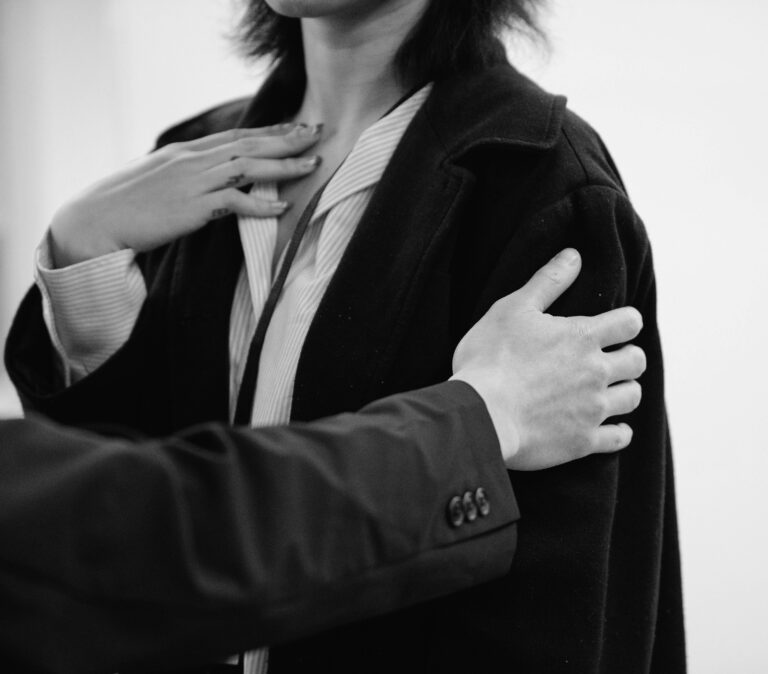
Her hand finds the pen and closes around it. Her weight shifts — one foot, then the other, a small search for ground that isn’t quite there. Her voice comes back a half-second too fast.
She hears herself explaining what didn’t need explaining, laying down evidence she has already laid down, reaching for one more point, and then another. There is an urge underneath it, older than this meeting: convince them. Bring them back. Do more, say more, and they will see it the way you see it.
And here is the strange part — she knows she is right. And at the very same moment, she can feel that it isn’t being received, that the words leaving her don’t carry the weight the numbers should. Her argument says one thing. Her body is telling a different story. Some part of her can hear both at once, and the mismatch only makes the urge louder.
So she does the only thing the urge knows how to do. She pushes harder.
The colleague who asked leans back. He has his answer; he is no longer listening for it; he is watching her deliver it — and watching is a different act than listening was. Someone glances at someone. A second question, already half-formed, is quietly set back down. The room that was leaning toward her a moment ago is now simply waiting for her to finish.
She wins the point. She does not feel the larger thing go.
What Being Defensive Under Pressure is Trying to Protect
To see why she cannot simply stay composed, you have to see what she is defending. It is not the numbers. The numbers can defend themselves.
What she is defending, in that half-second, is her standing — her credibility, her competence, the story the room tells about her when she has left it. This is the mechanism, the whole engine of it: a question about her work does not stay a question about her work. Below the level where she could intervene, it is filed under an older heading — threat — and sent to the place where her hard-won standing is kept. The figure was the trigger. Her position is what took the blow.
And her standing has rarely been as settled as her title suggests. She has usually had to earn the right to be taken at her word, and earn it again, in rooms that did not grant it by default. So the alarm is not false. It is memory. A challenge to her work reaches straight for the thing she has never quite been allowed to take for granted, and it pulls.
That is the trap. The trigger is small: one question, one figure. The threat she feels is total: her judgment, her place, what she represents to everyone who staked something on her being right. Her body does not weigh the two against each other. It answers the threat, not the trigger — at full strength, the way it learned to — and a proportionate question meets a response built for a far larger danger.
The room, of course, felt no threat. It saw a colleague ask about a figure. It cannot see what she is protecting, only the size of the protection — and an outsized defense of a small question reads, from the outside, as the very thing she was trying to disprove: that the ground beneath her is less solid than it looks. She defends her standing, and the defending is what calls it into question.
What Being Defensive Under Pressure Costs in the Room
It is not one meeting. It is what the room learns from it, and then teaches itself.
Watch the same colleague three weeks later. He is in another meeting, and he sees something — a soft spot in a plan she is about to approve, the kind of thing he would once have named without a second thought. He starts to speak. And in the half-second before he does, he remembers the last time: the speed of the correction, the weight of being answered instead of heard. He decides it isn’t worth it. He lets it go. The plan moves forward with the soft spot still in it.
Nothing happened. That is precisely the cost. Something that should have been said was not said, and no one will ever know it went missing — least of all her.
This is how the trust goes: not in a rupture, but in a thousand small withholdings, each one invisible, each one reasonable. Because trust, at her level, is not warmth and it is not being liked. It is the willingness of capable people to bring her their doubts while there is still time to use them — the bad news early, the dissent out loud, the half-formed better idea before the moment to act on it has passed. That willingness is what her decisions actually run on. It is what lets her lead on true information instead of the smoothed, safe version a careful room prefers to hand up.
And it is exactly what defensive under pressure costs. Each time she meets a challenge as a threat, the room learns that its honesty is costly — and a room that learns that stops paying. Not out of fear, quite. Out of ordinary sense. Why spend a doubt that will only cost you, on a leader who will only defend?
So the information thins. The doubts reach her late, after they have set into problems. The dissent that would have saved a decision is spoken in the corridor instead of the meeting. She becomes, by slow degrees, the last person in her own room to know what everyone already knows — and she decides on that narrowing supply. When one of those decisions goes wrong, she reads it as proof that she was right not to lean on the room, and she guards a little harder next time. The loop tightens around her.
Here is the cruelty of it. The reflex exists to protect her standing. What it walls out is the one thing that would have kept that standing sound: the room’s honest read, delivered in time. She is defending her authority by starving it of its own supply. The wall that keeps out the challenge keeps out the help.
And the last cost looks like strength. She ends up alone at the top — carrying more of the room than she used to and calling it responsibility, checked by no one, surrounded by people who agree in the meeting and settle the real question somewhere she cannot hear. It looks like authority. It is the shape left behind when authority has quietly gone.
What the room stops doing, long before anyone says a word
- The challenges stop. Not because the room agrees, but because disagreeing with her carries a price no one wants to pay twice.
- The bad news comes late. Problems reach her hardened, past the point where they could have been quietly solved.
- The real meeting moves. The question gets settled before the room convenes; the meeting only ratifies it.
- The dissent goes to the corridor. The thing that should have been said to her is said to everyone but her.
- She carries more. And reads the extra weight as the room doing less, rather than as a room that has stepped back.
These are not five frustrations. They are one message, in the only language a room speaks once it has decided a leader’s authority is safer left untested.
The Word in the Review
Eventually, someone writes it down.
The word is defensive. Sometimes it comes dressed for the occasion — “could be more open to input,” “finds challenge difficult,” “can be hard to give feedback to.” She reads it and feels the injustice of it, because from the inside she was never being difficult. She was being rigorous. She was being right.
And she was. That is the part the review cannot hold, and the part worth staying with: she was right, and the room withdrew from her anyway. Both are true, and the second does not cancel the first. Being right was never the question. The defending was.
This is what makes defensive under pressure so hard to correct, and why the word stings without helping. By the time she notices she is defending, the defending has already begun. The reflex is faster than the decision — and resolve does not reach it, because resolve lives in the thinking mind, and the reflex has already moved.
An Old Competence, in the Wrong Room
Because the reflex was never a flaw. It is an old competence, and it was once exactly the right one.
In the rooms that made her — where her authority was never assumed, where a challenge could genuinely cost her the position, where a point conceded was a foothold lost — meeting every question at full force and yielding nothing was not defensiveness. It was how she held her place in rooms not built to hold it for her. It is, quite literally, how she reached this one. A brilliant adaptation to those rooms.
The rooms have changed. She has the standing now; a question is no longer the opening move in taking it from her. But the reflex was never told the rooms had changed. It still reads every challenge as the old danger, still defends as though the seat could be lost in a sentence — and in guarding a position that is no longer under threat, it manufactures the very fragility it means to prevent. This is how defensive under pressure outlives the conditions that built it: the danger is long past, and the defense is still standing guard. The instinct that won her the room is the one now quietly emptying it.
How the Defensive Leader Under Pressure Begins to Change
By now, perhaps, you have not been reading about her.
Perhaps you know the meeting where you were right and something still went wrong afterward that you could never quite name. Perhaps you have found the word defensive in your own feedback and felt it miss everything that mattered — because you were being rigorous, and the cost of that rigor was visible to everyone but you.
If so, there is one thing worth watching, and it is not inside you. It is in the room. The next time you are challenged, answer as you always would — and then, afterward, watch what the room does. Whether the next question comes, or quietly doesn’t. Whether people lean toward you, or settle back. Whether the hard thing reaches you in the meeting, or in the corridor a week later. You will not have to guess what your certainty cost. The room keeps the account, and it will show you the balance, if you are willing to read it.
But reading it is not the same as changing it. The reflex that fires when your standing feels threatened was built over years, in rooms that were genuinely unsafe for it, and it changes the way it was built — through lived experience, not insight, and never by resolving to appear more open, which a room reads at once as one more thing being managed. It changes only where it actually lives: in the half-second, below thought, where a question is sorted into threat or not-threat before you have any say in it. Move it there, and you no longer have to defend your standing — because the challenge stops arriving as an attack on it. You can let a question be a question. The room feels the difference before you could name it, and slowly, it begins to come back.
That is the work I do with senior women. If defensive under pressure is the pattern your room has learned to work around, a call is where it begins — not to rehearse a better way through the next meeting, but to change what happens in you the moment the room pushes back.
You have the standing. The work is no longer having to defend it.
Schedule your free call here.