Reactive under pressure is the pattern almost no senior woman leader will say out loud — the moment she is challenged and something takes over before she can choose it. This piece is about what that reaction actually costs her in private, why the resilience training and executive-presence work she has already done never reaches it, and where it quietly begins to change. Not in the mind. In the body.
She knows her numbers. She has known them for weeks — through the late reads, the cross-checks, the version she rebuilt at midnight because the first one wasn’t quite honest enough. She stands to present, and for the first twenty minutes it holds.
Then a colleague — a peer, someone she respects — tilts his head and says he isn’t sure the figures add up.
And something moves in her before she has decided anything.
Her hand finds the pen and closes around it. Her weight shifts — one foot, then the other, a small search for ground that isn’t quite there. Her voice comes back a half-second too fast.
She hears herself explaining what didn’t need explaining, laying down evidence she has already laid down, reaching for one more point, and then another. There is an urge underneath it, older than this meeting: convince them. Bring them back. Do more, say more, and they will see it the way you see it.
And here is the strange part — she knows she is right. And at the very same moment, she can feel that it isn’t being received, that the words leaving her don’t carry the weight the numbers should. Her argument says one thing. Her body is behaving as though something more than the numbers is at stake. Some part of her can hear both at once, and the mismatch only makes the urge louder.
So she does the only thing the reactive urge under pressure knows how to do. She pushes harder.
None of this shows. She finishes, gathers her papers, says the right closing thing. The cost is quieter than that, and slower, and it belongs only to her.
It arrives that night, at eleven, in a quiet house, with the meeting still running.
She runs it back — what he said, what she said, the thing she should have said instead, the five calm words that would have ended it. She composes those words now, hours late, in the dark. She composes three versions of them.
She is tired in a way sleep doesn’t reach. Not the tiredness of a long day — the tiredness of holding. Because she is the one who holds it: the standards, the details, the plan, the line that doesn’t get crossed. She has held it so long that she no longer feels the weight as weight. She feels it as who she is.
No one sees this part. This is the part she pays in private.
What Being Reactive Under Pressure Actually Costs Her
It is not one meeting. It is the shape of her weeks.
She is the one who stays late to make the thing airtight. The one who rewrites the deck so no one can find the seam. The one who walks into rooms already braced, already three answers deep into questions no one has asked. She calls it being prepared. She calls it standards. She calls it caring more than the next person.
All of it is true. And all of it is drawing on something she has not named.
Because holding everything is not free. The vigilance runs in the background even when nothing is wrong — a low current, always on, pulling from the same place her steadiness is meant to come from. She is spending her authority to manufacture control. And the more she spends, the more she needs, because control built that way never quite holds on its own.
This is the real cost of being reactive under pressure. Not necessarily burnout — something quieter, and harder to name: the slow draw on a woman who has made herself responsible for holding what should not need to be held.
The thing she could never name
She has felt all of this for years without a language for it. Named plainly, it looks like this:
- The reaction is faster than the thought. Her body moves — the grip on the pen, the weight leaving center, the voice too quick — before her mind has chosen anything.
- The urge is to convince, not to state. Being right stops feeling like enough; she reaches to win the room instead of to hold her ground.
- She can feel the mismatch. She knows she is right, and she can feel it is not being received — and the gap only makes her push harder.
- The meeting does not end when it ends. It runs again at eleven at night, in three rewritten versions.
- The tiredness is not from the work. It is from the holding — the vigilance that never fully switches off.
These may look like separate problems, but they are one pattern, surfacing in five places.
And she is not the only one.
Ask senior women what they most want to change about the way they lead under pressure, and the answer comes back almost unanimous: they want to be strategic instead of reactive. To stay with the plan instead of scrambling to defend it. To be the composed one — the one who does not have to run the meeting back at eleven at night.
So many of them reaching for the same thing. Which means it is not random. It has a shape — and a shape is something that can be worked with.
The Problem Isn’t Strategy
But look closely at what they are asking for, because the language hides something.
She is not short on strategy. She is the strategist. She builds the plan, sees three moves out, holds the whole board in her head. Strategy is the one thing she has never lacked.
So when it vanishes the instant she is challenged — when all of that capability is right there and she still cannot reach it — the problem was never strategy. It is the state from which she is trying to access it.
Why the Usual Tools Fail in the Moment
By now she has tried to fix it. Of course she has. She fixes things.
She has done the resilience training. Read the books on executive presence. Taken the leadership program, practiced the frameworks, rehearsed the pauses. She has a folder of techniques for exactly this moment.
And in the calm of preparation, they all work.
Then the pressure arrives, and the folder is gone. The technique that was right there an hour ago cannot be found when she reaches for it. The method was aimed at the wrong altitude.
Even when understood and practiced, these tools still depend on her being able to access them in the moment.And the reaction does not wait for the thinking mind: by the time she could reach for a technique, her body has already answered.
So what goes missing in that half-second?
Her authority. Not her competence, not her intelligence, not her strategy — those stay. What she loses access to is the felt, bodily sense of her own ground. The thing that lets a person hold a position without pushing it. The steadiness that does not need to convince, because it is already settled.
Authority, it turns out, is not only something the mind knows. It is something the body has to be able to hold under pressure. And when her standing is challenged, her body responds before she has consciously chosen how to respond.
Because this is not malfunction. It is adaptation.
In the rooms that shaped it — where authority was not granted to her by default, where she had to earn every inch of standing — working harder, producing more, closing every gap before anyone could open it was precisely the intelligent move. A brilliant adaptation to those rooms. A one that helped her navigate the rooms in which she had to earn that standing.
The response is not broken. It is doing the exact job it was built for — only now in rooms that no longer require it, spending her authority to defend a position her authority alone could hold.
The strength that built her standing is the same one now quietly spending it.
How the Reactive Leader Under Pressure Begins to Change
None of this changes in a day. But something can begin today, and it is smaller than you expect.
Because by now, perhaps, you have not been reading about her at all. Perhaps you recognized the pen in your own hand, the meeting that runs again at eleven at night, the certainty that you are right and the quiet sense that it is not being received. If so, the recognition has already done its first work: the pattern is no longer invisible to you.
Being reactive under pressure is a fast impulse, but not silent. Before the words come too quickly, your body has already spoken — your hand closing, your weight leaving center, your breath gone high and shallow. They are the first signal, arriving a half-second ahead of the urge to convince.
The typical executive coaching runs the other way — override the impulse, feel nothing, carry on. Which is why signal goes unread: not because it is faint, but because noticing it was never the skill anyone rewarded.
But the signal can be caught. Not managed, not suppressed — noticed. And in the space that noticing opens, however small, something becomes possible that was not there a moment before: a choice, where there was only reflex.
So here is the one question worth sitting with, the next time the room tightens:
What does my body do first — before I say anything at all?
You do not have to fix it. You only have to catch it. That noticing is not a small thing. It is the first place the pattern becomes visible from the inside — and a pattern you can see is a pattern that has already begun to loosen its grip.
And still — noticing is the doorway, not the room.
You can feel the pattern move now. What you cannot yet see, from inside it, is its full shape: where it comes from, what it protects, which version of it you run. Because there is not one pattern. There are a few, and they are not the same. The woman who pushes harder is not running the same program as the one who goes quiet or the one who smooths everything over before anyone feels the friction.
Each is its own adaptation. Each asks for a different way back to steadiness.
Knowing which one runs your leadership is where the real work starts — because a pattern you can name is a pattern you can work with, instead of one that keeps working you.
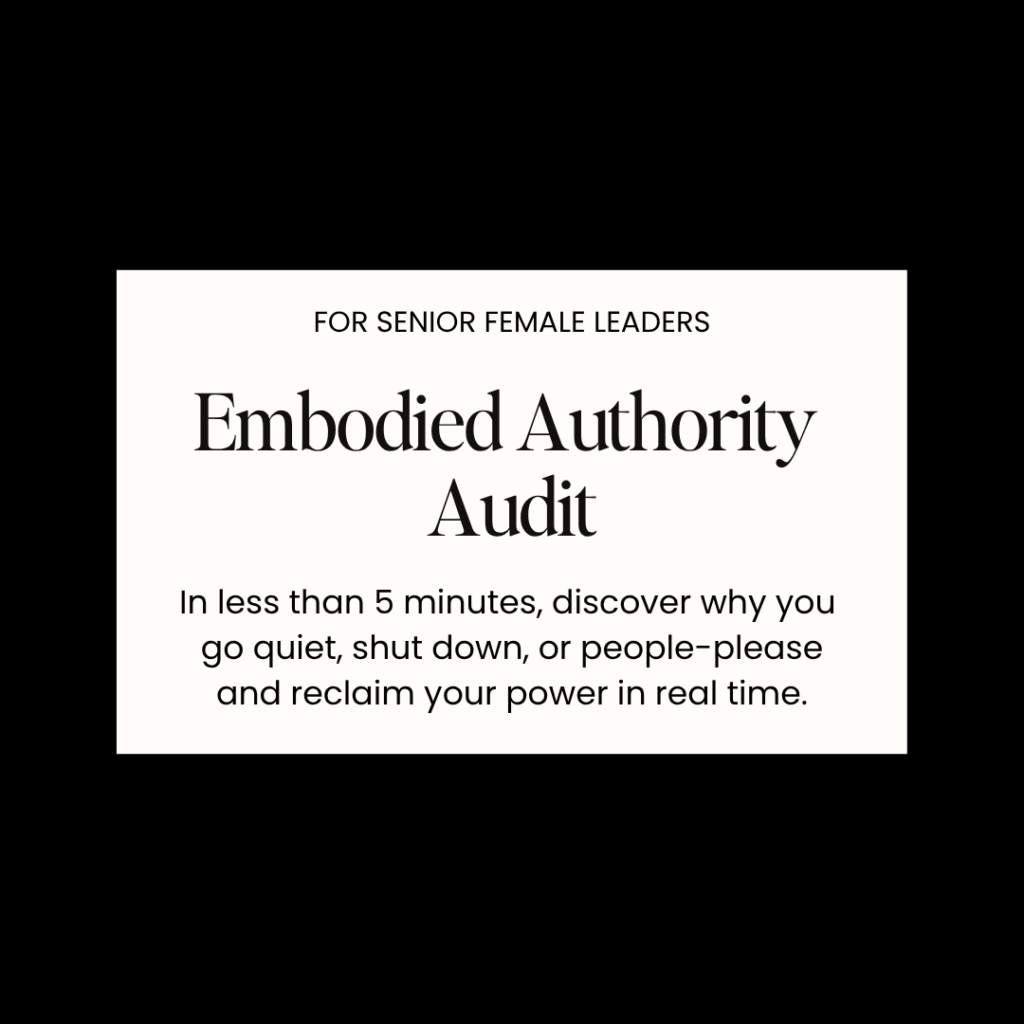
That is what the Embodied Authority Audit is for: a short set of questions that shows you which pattern is shaping your leadership, what it is costing you, and where to begin interrupting it.
You have carried it a long time, in private.
It is worth seeing clearly. Start here.